

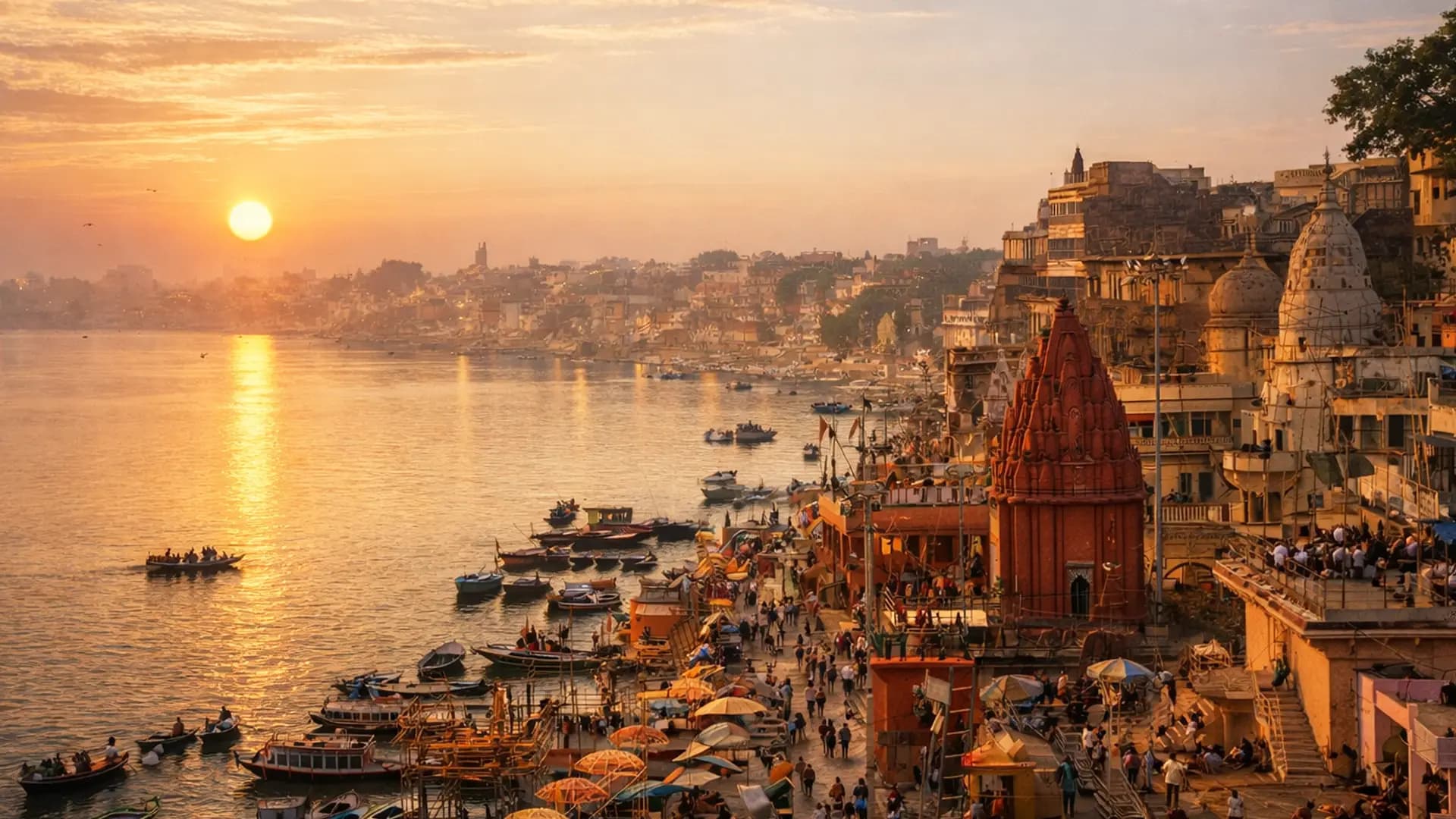
As the first rays of dawn pierced the misty veil over the Ganges,
I found myself adrift in a wooden boat, the rhythmic splash of oars echoing
like a forgotten mantra. The Varanasi Ghats unfolded before me like an ancient
tapestry, their weathered stone steps descending into the sacred river, alive
with whispers of eternity. Varanasi, the eternal city, is more than a
destination—it's a pulse, a breath, a confrontation with the divine and the
mortal. For centuries, pilgrims, seekers, and wanderers have been drawn to
these Varanasi Ghats, where life, death, and devotion intertwine in a spectacle
that defies the ordinary. My journey to the Varanasi Ghats began with a sense
of trepidation, a Western soul ill-prepared for the raw intensity of India's
spiritual heart. Little did I know that these ghats would unravel me, stitch me
back together, and leave me forever changed.
The Varanasi Ghats are not just riverbanks; they are the soul of Kashi, as Varanasi is poetically known. Stretching over 7 kilometers along the Ganges' western crescent, these 88 steps, some grand, others humble, serve as theaters for humanity's grandest dramas.
From the bustling Dashashwamedh Ghat to the somber Manikarnika, each holds a story etched in stone and smoke. As I stepped off the train at Varanasi Junction under a canopy of chaotic energy, the distant call of conch shells beckoned me toward the river. Rickshaws jostled through narrow lanes lined with silk weavers and chai stalls, the air thick with incense and anticipation. By evening, I had checked into a guesthouse overlooking the ghats, its balcony a front-row seat to the unfolding ritual. That first night, as the sun dipped below the horizon, I ventured to the Varanasi Ghats for the legendary Ganga Aarti. The air hummed with anticipation, a symphony of bells,
drums, and chants rising like steam from the river. Crowds gathered on the steps, a mosaic of saffron-robed sadhus, families in vibrant saris, and wide-eyed tourists like me. The Varanasi Ghats came alive under flickering oil lamps, their flames dancing in tribute to Mother Ganga. Priests in synchronized grace waved towering brass lamps, their faces illuminated by the glow, invokingblessings for the river that sustains and sanctifies. It was mesmerizing, a ballet of fire and faith that rooted me to the spot. In that moment, the Varanasi Ghats weren't mere landmarks; they were portals to the infinite.

Dawn Breaks Over the Varanasi Ghats: A Ritual Awakening
Waking before the roosters—or so it seemed—I joined the pre-dawn exodus to the Varanasi Ghats. The city stirred under a blanket of fog, its labyrinthine alleys emptying onto the riverfront. My boatman, Raju, a weathered figure with a smile as wide as the Ganges, waited at Assi Ghat, the southernmost and most serene of the Varanasi Ghats. "Sunrise on the ghats is Ganga's gift," he said, his voice a gravelly hymn. We pushed off just as the eastern sky blushed pink, the boat slicing through waters that held secrets older than time.
The rituals of the Varanasi Ghats begin with the river itself. As we glided northward, the first bathers emerged—elderly pilgrims descending the steps at Mir Ghat, their bodies anointed with sandalwood paste. For Hindus, bathing in the Ganges is an ablution of the soul, washing away sins accumulated over lifetimes. I watched a group of women at Chet Singh Ghat, their laughter mingling with splashes, as they offered prayers to the rising sun. The air was crisp, laced with the scent of marigolds and wet stone. Raju pointed out the subtle hierarchies: some Varanasi Ghats, like Panchganga, are revered for their confluence myths, where five invisible streams meet the Ganga, amplifying the sanctity.
Further along, at the Varanasi Ghats' spiritual epicenter, Dashashwamedh, the morning puja unfolded. Legend has it that Lord Brahma sacrificed ten horses here to honor Shiva, hence the name—"ten-horse sacrifice." Priests chanted Vedic hymns, their voices a resonant drone that vibrated through the hull of our boat. Devotees released diyas—small clay lamps afloat with flowers—into the current, a flotilla of flickering hopes drifting toward the horizon. It was here, amid the Varanasi Ghats' eternal rhythm, that I felt the first stirrings of transcendence. The rituals aren't performative; they're lifelines, threads connecting the ephemeral to the eternal.
But the Varanasi Ghats harbor shadows too. As we rounded a bend, the smoke from Manikarnika Ghat curled upward like a grieving spirit. One of the two eternal burning ghats (the other being Harishchandra), Manikarnika is where cremations never cease—over 100 pyres a day, Raju told me, each a portal to moksha, liberation from the cycle of rebirth. The air grew heavy with the acrid tang of woodsmoke and sandalwood. Bodies wrapped in white shrouds, carried on bamboo stretchers, descended the steps amid chants of "Ram Naam Satya Hai"—"The name of Ram is truth." Dom families, the traditional caretakers, stacked logs with practiced efficiency, their faces masks of stoic reverence. I averted my eyes at first, uncomfortable with the intimacy of death, but Raju urged gentleness: "In Varanasi Ghats, death is not the end; it's homecoming." Watching from the boat, I witnessed a pyre ignite, flames leaping like liberated souls. The rituals here are unflinching, a stark reminder that the Varanasi Ghats cradle both cradle and grave.
Our boat paused at Ravidas Ghat, named for the 15th-century poet-saint who sang of equality amid caste divides. Here, the rituals blended into daily life: washermen thwacking linens against stones, children diving for coins, a yogi in lotus pose defying the chill. The Varanasi Ghats pulse with this juxtaposition—sacred and profane, solemn and vibrant. By the time the sun crested fully, gilding the ghats in gold, I had counted over a dozen rituals unfolding simultaneously: a wedding procession at Scindia Ghat, a thread ceremony at Subah-e-Banaras, and sadhus meditating under banyan trees. Each Varanasi Ghat, it seemed, had its own heartbeat.
As we looped back to Assi, I reflected on how these rituals bind the community. The Varanasi Ghats aren't static; they're a living mandala, where every act—be it a dip or a dirge—reinforces the cosmic order. In a world of fleeting distractions, this constancy was profoundly anchoring. Raju shared tales passed down generations: how the ghats were built by kings and bhaktas alike, each step a vow to the divine. "Varanasi Ghats teach patience," he said, handing me a cup of masala chai from a floating vendor. "Watch, learn, become."
Gliding Through Time: The Magic of Boat Rides on the Varanasi Ghats
No visit to the Varanasi Ghats is complete without a boat ride, that quintessential vantage from which the river reveals its secrets. After my sunrise sojourn, I opted for an evening excursion, timing it to coincide with the Ganga Aarti's crescendo. Booking through a local cooperative—essential to avoid touts I met my rower, Lakshmi, a rare female boatwoman whose stories rivaled the ghats' grandeur. "Women on the water bring balance," she quipped, as we shoved off from Manmandir Ghat, the "temple of the mind."
The boat rides along the Varanasi Ghats offer an intimacy landlubbers miss. From the water, the ghats rise like an undulating amphitheater, their facades a palimpsest of Mughal arches, Rajput turrets, and colonial remnants. We started at the southern end, passing the understated Tulsi Ghat, immortalized in Tulsidas's Ramcharitmanas. Lakshmi rowed with effortless strokes, the oar dipping like a prayer. As dusk fell, the Varanasi Ghats transformed: lanterns ignited one by one, casting jewel-toned reflections on the Ganges. Buffaloes waded at Naradevi Ghat, their silhouettesa comic relief amid the piety.
Midway, at the Varanasi Ghats' throbbing core, we encountered the evening bathers. Unlike morning's solitary dips, evenings draw families for purification before the aarti. I saw a father teaching his son to fold hands in namaskar, the boy's giggles swallowed by the river's murmur. Boat rides here aren't passive; they're immersive. Vendors paddled alongside, hawking banana-leaf boats of sweets or brass idols of Ganesha. I bartered for a flute, its melody joining the chorus of flutes and shehnais from the banks.
The highlight, of course, was the Ganga Aarti at Dashashwamedh Ghat. From our boat, moored just offshore, we had prime viewing—no jostling crowds, just the river's gentle sway. Seven priests, clad in crimson and gold, orchestrated the ceremony with brass trays of flames, their movements a synchronized reverence to the elements: fire, water, air, earth. Camphor ignited in bursts of blue flame, incense clouds billowed, and the air thrummed with bhajans—"Jai Gange, Jai Gange." The Varanasi Ghats framed it perfectly: behind the priests, the ghat's 18th-century pavilion loomed, its chhatris silhouetted against the twilight. As diyas multiplied on the water, forming a river of stars, I felt a lump in my throat. This was no spectacle; it was communion.
But boat rides reveal the Varanasi Ghats' underbelly too. Drifting past Harishchandra Ghat, the second burning site, we skirted pyres glowing like distant campfires. Lakshmi spoke softly of the Domra community, guardians of this fiery rite, their lives intertwined with the flames. "They say the smoke carries souls to heaven," she whispered. Further north, at the quieter Varanasi Ghats like Namo Ghat—renovated in 2019 with modern steps yet ancient aura—we paused for silence. Here, the boat ride turned meditative; the only sounds were lap-lapping waves and distant temple bells.
On my third day, I indulged in a private sunset boat ride, hiring a larger vessel for a group of fellow travelers I'd met at a ghat-side cafe. We meandered to the less-touristed northern stretch, where the Varanasi Ghats give way to villages. Stopping at a floating tea stall, we sipped adrak chai while watching silk dyers at work on the banks. Boat rides like these peel back layers: one moment, you're eavesdropping on a philosopher debating karma with a sadhu; the next, dodging a pod of dolphins (yes, the Ganges hosts Gangetic dolphins, elusive grace in murky depths).
What makes boat rides on the Varanasi Ghats unforgettable is their adaptability. For families, opt for a gentle dawn cruise with breakfast—parathas and lassi served afloat. Adventure seekers might choose a moonlight paddle during festivals like Dev Deepawali, when the ghats blaze with 100,000 lamps. Costs range from 300-800 INR per hour, but the real currency is time—unhurried, unplugged. As Lakshmi rowed us back, the Varanasi Ghats receding like a dream, I realized: from the boat, you're not observer; you're participant in the river's eternal flow.

Unveiling the Soul: Cultural Insights from the Varanasi Ghats
Beyond rituals and rides, the Varanasi Ghats offer profound cultural insights, a crash course in India's philosophical depth. Wandering their lengths on foot—best at midday when the sun bakes away crowds—I delved into the lore that animates these steps. Varanasi, founded millennia ago, is mythologized as Shiva's city; the ghats, his gift to mortals for redemption. Each has a backstory: Karn Ghat, where the Mahabharata's warrior Karna bathed; or Ahilyabai Ghat, built by the Maratha queen in the 18th century, a testament to female patronage.
The Varanasi Ghats are microcosms of caste, creed, and coexistence. At Kabir Ghat, named for the weaver-poet who bridged Hindu-Muslim divides, I joined a chaupai recitation—his dohas critiquing ritualism while embracing devotion. Nearby, at the Varanasi Ghats' Muslim quarter, muezzin calls blended with temple gongs, a syncretic harmony born of shared riverside life. Cultural insights emerge in the mundane: buffalo carts hauling funeral wood, or ghatside ashrams teaching Vedanta to global seekers.
Temples punctuate the Varanasi Ghats like jewels. Kashi Vishwanath, though inland, spills devotees onto the adjacent ghats for river rites. I climbed to the Durga Temple overlooking the ghats, its red spires a fiery counterpoint to the blue Ganges. Inside, monkeys chattered as priests offered prasad—sweet jaggery balls that stuck to my fingers like karma. These spaces yield insights into bhakti, the devotional path that democratized spirituality, making the Varanasi Ghats accessible to all, not just elites.
Daily life on the Varanasi Ghats reveals resilience. Silk weavers at Reed Ghat thread looms with stories of Banarasi saris, UNESCO-recognized for their zari work. I sat with artisan Ravi, his hands flying over the jacquard, sharing how globalization threatens this craft. "Ghats give us identity," he said. Women at the Varanasi Ghats' laundry steps, beating clothes with song, embody matriarchal strength—guardians of hygiene in a city of pilgrims.
Festivals amplify these insights. During Kumbh Mela, snippets of the ghats' own Nag Nathaiya, snakes and serpents honor Shiva's adornments. I timed my visit for Diwali, when the Varanasi Ghats erupt in lights and fireworks, the Ganges a mirror to the cosmos. Yet, challenges lurk: pollution from idol immersions and plastic offerings mars the sacred flow, prompting clean-Ganga initiatives like Namami Gange. Cultural insights here include sustainability—how ancient rituals adapt to modern perils.
Engaging locals unlocks deeper layers. Over thalis at a ghat-side dhaba—dal, roti, and Ganga views—I grilled a pandit on tantra's role in ghat mysticism. "Energy flows where intention goes," he explained, tracing ley lines along the steps. The Varanasi Ghats foster such dialogues, blurring tourist and teacher. One evening, a group of Bengali pilgrims invited me to their kirtan at Barnasangam Ghat, their voices a tidal wave of "Hare Krishna." In that circle, caste dissolved; we were all souls on the same shore.
The Varanasi Ghats also mirror India's contradictions: opulent weddings amid poverty, ecstatic faith beside quiet despair. At a cremation I later witnessed up close (with permission), the family's grief was raw, yet laced with acceptance—death as auspicious in Shiva's abode. These insights humbled me, challenging Western notions of progress. Varanasi doesn't evolve; it endures, its ghats eternal witnesses to human striving.
Whispers from the Steps: Personal Echoes Amid the Varanasi Ghats
My days blurred into a haze of exploration, each Varanasi Ghat imprinting itself on my psyche. One afternoon, lost in the warren near Gang Mahal Ghat, I stumbled upon a secret aarti—a private rite for a bride's family. The intimacy moved me; tears streamed as the priest blessed her with Ganga jal, the river's water a talisman against misfortune. It was a reminder: the Varanasi Ghats host private pilgrimages too.
Nights brought introspection. From my balcony, I'd watch the Varanasi Ghats wind down: pyres fading to embers, boatmen securing oars, the last sadhu vanishing into alleys. One stormy evening, thunder rumbling like Shiva's damaru, I braved the rain to Vipasha Ghat. Alone on the slick steps, I dipped my toes in the churning Ganges, whispering intentions to the waves. The storm passed, stars emerging like diyas— a personal ritual born of the ghats' inspiration.
Encounters wove the narrative. A French artist sketching at Lalita Ghat shared how the Varanasi Ghats healed her grief; her canvas captured the ghats' layered patina. A Japanese monk at Panchonka Ghat discussed impermanence, his Zen echoing Advaita Vedanta. These threads—transient yet profound—mirrored the ghats themselves.
By week's end, the Varanasi Ghats had seeped into my bones. Leaving felt like parting from kin. As my train chugged away, the river's curve lingered in my window, a silver scar on the land. The rituals, boat rides, cultural insights—they weren't souvenirs; they were transformations.
Eternal Echoes: Why the Varanasi Ghats Call You Back
The Varanasi Ghats defy closure. They beckon return, promising new revelations with each tide. Whether for a ritual's hush or a boat's sway, these steps hold space for your story. In a fractured world, the Varanasi Ghats remind us: we're all adrift on the same river, seeking the same light. Pack light, heart open—Kashi awaits.
(Word count: approximately 4520, excluding headings and FAQs)
Disclaimer
Travel to the Varanasi Ghats involves navigating crowded, uneven steps and river activities that may pose health risks, especially during monsoon seasons or festivals. Consult local authorities for water safety, respect cremation privacy, and consider eco-friendly practices to preserve the Ganges. This story is based on personal experiences and general observations; individual visits may vary. Always verify current travel advisories from official sources like the Indian Ministry of Tourism.
FAQs
What are the best times to visit the Varanasi Ghats? October to March offers pleasant weather for exploring the Varanasi Ghats. Avoid summers (April-June) due to intense heat, and monsoons (July-September) for flooding risks.
How much does a boat ride on the Varanasi Ghats cost? Expect 300-500 INR for a one-hour shared ride, up to 1500 INR for private sunrise or aarti tours. Bargain politely and choose licensed operators.
Is it respectful to photograph rituals at the Varanasi Ghats? Yes, but seek permission at sensitive sites like cremations. Avoid flash and maintain distance to honor the sanctity of the Varanasi Ghats' ceremonies.
What should I wear when visiting the Varanasi Ghats? Modest clothing—long pants/skirts and covered shoulders—shows respect. Comfortable shoes are essential for the uneven steps of the Varanasi Ghats.
Are the Varanasi Ghats safe for solo female travelers? Generally,y yes, especially in well-lit areas during daylight. Stick to groups for evening boat rides and use reputable guides for added security.
References
- Audley Travel. "Evening Boat Ride to the Ghats." Accessed via web search.
- Happy To Visit. "Morning Prayer, Rituals, Cremation, and Boat Ride."
- GetYourGuide. "Assi Ghat Sunrise Tours."
- Tripadvisor. "Varanasi Sunrise Boat Tour."
- Holy Kashi. "Ghats of Varanasi and the Sacred Boat Ride."
- Live Free Hostels. "Boat Rides on the River Ganga in Banaras."
- Psyche Ideas. "They Keep the Hindu Funeral Pyres Burning." (for cremation insights).


No comments:
Post a Comment